

The phrase what cilfqtacmitd help with has been showing up in searches, forums, and exploratory discussions, yet it often lacks a clear, unified explanation. People encounter it, feel curious, and then struggle to find a grounded answer that explains what it actually does or why it matters. This article exists to close that gap with a careful, practical, and easy-to-understand breakdown.
When readers ask what cilfqtacmitd help with, they usually want to know three things: what the concept refers to, how it applies in real situations, and whether it offers genuine value. Rather than guessing or overhyping the term, this guide explains cilfqtacmitd as a functional framework—how it works, where it helps, and how people can think about it responsibly.
Understanding the Concept Behind Cilfqtacmitd
Cilfqtacmitd is best understood as a structured problem-support concept rather than a single tool or product. It represents a method of organizing inputs, constraints, and outcomes so that complex challenges become easier to evaluate and act on. People often encounter it when dealing with layered decisions, abstract systems, or situations where clarity feels hard to reach.
At its core, cilfqtacmitd focuses on context alignment. It helps users connect intent with execution by identifying what matters most in a given situation. Instead of offering rigid rules, it encourages adaptive thinking and informed choices.
Several characteristics define the concept:
- Context sensitivity: It adapts to different environments rather than forcing a single solution.
- Outcome orientation: It emphasizes results, not just processes.
- Clarity over complexity: It reduces noise so decision-makers can focus on essentials.
Because of these traits, cilfqtacmitd often appears in discussions about strategy, analysis, learning frameworks, and optimization.
What Cilfqtacmitd Help With in Practical Scenarios
Strategic Thinking and Decision Support
One of the strongest areas where what cilfqtacmitd help with becomes clear is strategic thinking. When individuals or teams face multiple options with competing priorities, cilfqtacmitd helps structure the decision space. It encourages people to define goals clearly, weigh trade-offs, and align actions with long-term objectives.
Rather than replacing judgment, it sharpens judgment. Users gain a clearer view of why they choose one direction over another.
Simplifying Complex Information
Modern work and learning environments often overwhelm people with data. Cilfqtacmitd helps by offering a way to filter information based on relevance and impact. Instead of processing everything at once, users focus on variables that truly influence outcomes.
This approach supports better comprehension and reduces mental overload, especially in analytical or planning roles.
Supporting Adaptive Learning
Learning rarely follows a straight line. Cilfqtacmitd supports adaptive learning by encouraging reflection and adjustment. When something does not work as expected, the framework helps users identify why and refine their approach.
Educators, self-learners, and professionals often use similar principles to improve retention and skill development.
Key Benefits of Applying Cilfqtacmitd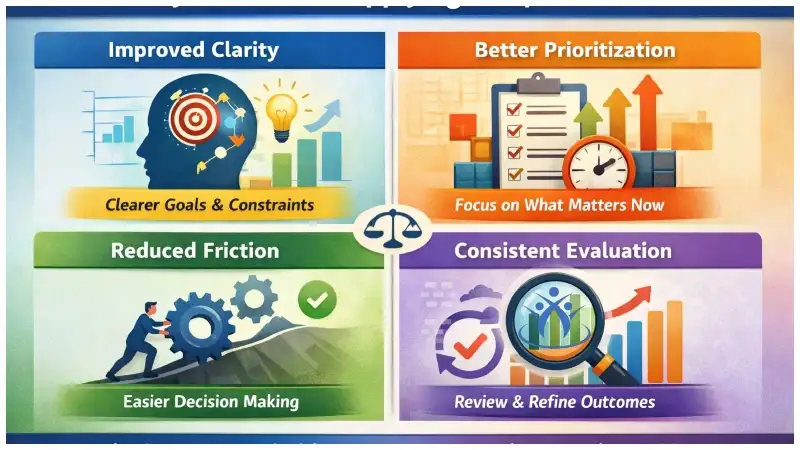
Cilfqtacmitd delivers value because it balances structure with flexibility. Some of its most notable benefits include:
- Improved clarity: Users gain a clearer understanding of goals and constraints.
- Better prioritization: It becomes easier to identify what deserves attention now versus later.
- Reduced friction: Decisions feel less overwhelming when framed systematically.
- Consistent evaluation: Outcomes can be reviewed and refined using the same logic over time.
These benefits explain why the concept appeals to people who deal with uncertainty, complexity, or evolving requirements.
What Cilfqtacmitd Help With in Problem Solving Frameworks
In problem solving, what cilfqtacmitd help with centers on breaking down challenges into manageable components. Instead of treating a problem as one massive obstacle, cilfqtacmitd encourages structured exploration.
Users typically follow three stages:
- Clarify the problem: Identify what actually needs to be solved.
- Map influencing factors: Recognize constraints, resources, and risks.
- Evaluate possible paths: Compare options based on defined priorities.
This structured flow supports better outcomes without forcing a single “correct” answer.
Applications Across Different Fields
Professional and Business Contexts
In business settings, cilfqtacmitd often supports planning, resource allocation, and performance review. Teams use similar logic to align daily actions with broader goals. Managers value it because it promotes consistency while allowing autonomy.
Personal Development
On a personal level, people apply cilfqtacmitd when setting goals, managing time, or navigating life transitions. The framework helps clarify values and translate them into practical steps.
Research and Analysis
Researchers and analysts use cilfqtacmitd-style thinking to organize hypotheses, evaluate evidence, and interpret results. It supports disciplined inquiry without limiting creative insight.
Common Misunderstandings About Cilfqtacmitd
Some people assume cilfqtacmitd represents a rigid system or proprietary method. In reality, it works more like a mindset or adaptable framework. Others expect instant answers, but cilfqtacmitd requires thoughtful engagement to deliver value.
Another misconception involves overapplication. Not every situation needs formal structuring. Cilfqtacmitd works best when complexity or uncertainty justifies the effort.
How to Use Cilfqtacmitd Effectively
To get real value, users should approach cilfqtacmitd with intention:
- Start with clear objectives.
- Avoid overcomplicating the framework.
- Revisit assumptions as conditions change.
- Use it as a guide, not a rulebook.
When applied thoughtfully, cilfqtacmitd supports insight without slowing momentum.
The Broader Value of Cilfqtacmitd Thinking
Cilfqtacmitd reflects a broader shift toward intentional, context-aware decision-making. In environments where information moves fast and stakes feel high, people benefit from frameworks that promote clarity and adaptability.
This approach aligns well with modern problem-solving needs, especially in roles that require both analysis and creativity.
Conclusion
In the end, what cilfqtacmitd help with comes down to clarity, alignment, and smarter decision-making. It does not promise shortcuts or perfect answers, but it offers a practical way to navigate complexity with confidence. When people use cilfqtacmitd as a flexible framework rather than a fixed rule, it becomes a powerful support tool across professional, educational, and personal contexts.
FAQs
- Where did the term cilfqtacmitd originate?
The term appears to have emerged from exploratory or conceptual discussions rather than a single formal source. - Is cilfqtacmitd a tool, software, or methodology?
It functions more like a conceptual framework than a physical tool or application. - Can beginners apply cilfqtacmitd effectively?
Yes, beginners can use it by focusing on basic structure and clear goals. - Does cilfqtacmitd replace experience or intuition?
No, it complements experience by adding structure to intuitive thinking. - How can someone evaluate whether cilfqtacmitd is working for them?
Users can assess it by reviewing clarity, decision confidence, and outcome consistency over time.